
The first step to going camping should be to choose a tent. Considering the needs of family outings, the focus of choosing a family tent may differ from choosing an outdoor tent. Unlike outdoor campers, most families drive directly to the campsite, so they do not have high requirements for the weight and volume of the tent itself. Today, let’s talk about some reference elements for choosing a tent.
A tent that is suitable for families in terms of appearance is best for adults to stand up in the tent. This way, even if camping encounters bad weather, you can still play in the tent. The common shapes of family tents include traditional conical tents, tunnel tents, and multilateral tents. The tunnel type tent we see the most in the camp.
The following are some tent related information that you often see when selecting tents:
Tent Capacity: For a tent with only one room, the capacity here refers to the number of people that can sleep in the tent without placing anything. When we take our children on trips, we naturally carry a lot of clothes, toys, and so on. Considering these factors, when purchasing a family tent, choose a tent that can accommodate more people than the existing family based on the size of the family. For families of three, it is recommended to have a tunnel type tent for at least four people. For families of four, it is recommended to have a tunnel tent with at least 5 people or a single room tent with 6-8 people.
In the world of tents, a width of 1.3 meters is considered a double room…
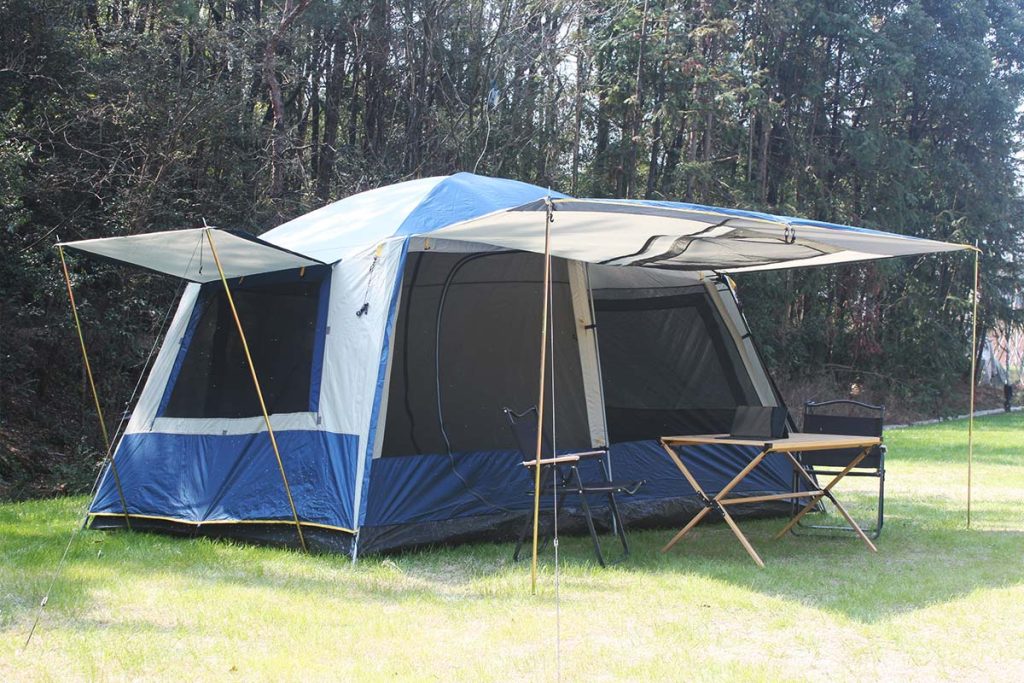
Number of rooms: Traditional conical and polygonal tents generally only have one open space. Tunnel tents can provide more rooms. The advantage of this type of tent is that it can distinguish the bedroom from the activity space and have better planning for the space. You can also move around in the living room when it rains. Camp equipment can also be stored in the living room, making it convenient to maintain the cleanliness of the camp
Poles: The commonly used family tents include steel structures, fiberglass structures, and inflatable column structures. The steel structure is more stable, but heavier in weight. Glass fiber structures are generally lighter and have good toughness, and most smaller tunnel tents are made of glass fiber. Inflatable column tents are relatively more expensive, but they are more convenient to install.
Ground sheet: Ground sheet can be used separately or integrated with the tent. When choosing a tent, it is recommended to fully integrate it with the tent. On the one hand, it provides better moisture-proof and rainproof measures, and on the other hand, it also prevents insects from crawling into the tent from the gaps between the moisture-proof cloth on the ground and the tent.
Fabric: The common tent material is mainly polyester fiber. On the one hand, the price is cheap, and the waterproof performance is also better than cotton. Nylon nylon is generally used for outdoor professional tents due to its lighter weight. Some also add waterproof and sunscreen coatings to the fabric.
Hydrostatic Head or Water Column: The waterproofing index is specific to tent materials, meaning how high a water column is placed on top of the material to begin leaking water. The higher the index, the better the waterproof performance of the material. Of course, the waterproofing of tents is not equivalent to the waterproofing of materials. Also pay attention to the position of the seam and zipper at the tent stitching interface to ensure that they are covered and the sealing is intact.
After considering the above factors, one can also take a look at the “livability” of tents. Is there storage space (for bags) and a place to hang lights.