
The first step to going camping is to choose a tent. Considering the needs of family outings, the emphasis of family tents will be different from that of outdoor tents. Unlike campers in the wild, most families drive directly to the campsite, so the weight and volume of the tent itself will not be too high requirements, today let you talk about some reference factors for choosing a tent.In terms of appearance, family-friendly tents are best for adults to stand up in the tent. So even if camping in bad weather, can also play in it. Common family tent shapes include: tunnel tent, multilateral tent. What we see most in the camp are# tunnel tents.
Here’s a list of things you’ll often see when you’re looking for a tent:
- Tent Capacity: For a one-room tent, capacity refers to the number of people the tent can sleep without placing anything in it. When we travel with our children, of course, we carry lots of clothes and toys and so on. With these considerations in mind, when purchasing a family tent, choose a tent that can accommodate more people than your existing family, depending on the size of the family. For a family of three, a tunnel-type tent with at least four people is recommend. For a family of four, a tunnel-type tent with at least five people is recommend, or a single-room tent with 6-8 people.In the tent world, three feet wide is consider a double roomA canopy.
- Number of Rooms: Traditional family tent and polygonal tents generally have only one open space. Tunnel tents can provide more rooms. The advantage of this kind of tent is that you can separate the bedroom from the activity space, and you can plan the space better. You can also play in the living room when it rains. Camp equipment can also store in the living room to keep the camp clean.
- Arbor Structure (Poles) : The poles commonly used home tents include steel structure, fiberglass structure, and gas-filled column structure. Steel is more stable, but heavier. Fiberglass structure is generally lighter, has better toughness, most small tunnel tents are fiberglass.
- Flysheet: Flysheet can be separate or integrated into the tent. When choosing a tent, it is recommend to fully integrate with the tent. On the one hand, better moisture and rain protection, on the other hand, also prevent insects from crawling into the tent through the gap between the ground sheet and the tent.
- Fabric: polyester, Nylon and cotton are the main types of tents. Polyester holds water better than cotton. Nylon use for outdoor professional tents because it is lighter. Some also add waterproof and sunscreen coatings to the fabric.
- Waterproofing index : The waterproofing index is for the tent material, which means how high the water column on the material will start to leak. The larger the index, the better the water resistance of the material. Of course, the waterproof tent is not the same as the waterproof material. Pay attention to how the Seams and zippers are covered and have good seams.
Considering the above factors, you can take a look at this tent
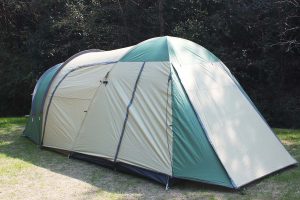
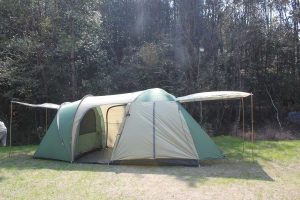
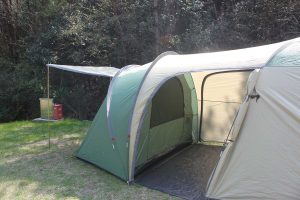
The tent size is 400 * 240 * 210 cm, for 4 to 6 people use, two big room with interior door provide adequate space for the whole family, and each have two big awning, in order to increase the shadow. Large Windows and doors keep you comfortable in warm weather
Tent material is made of 190T polyester, glass fiber pole, PE floor, waterproof up to 2000, glass fiber pole is light and easy to install, PE floor makes waterproof better
Tent internal use gauze, invisible mesh can prevent insects out,innovation framework system makes easy set
Please click the link for product details:www.hawktent.com