
How to choose your family tent?
The choice of your family tent depends on how you will use it and how you travel.
Depending on the number of people to be accommodated, your budget or your holiday destination, your selection criteria will not be the same.
And of course, your choice of tents will be narrowed down according to the importance you give to each criterion .
Here are the criteria to be taken into account:
Family tent capacity

The first criterion to look at. You all want to be able to get into the tent and make yourself comfortable.
So first look at the capacity (number of people) indicated by the tent manufacturer.
Some manufacturers add a “+” sign after the number of people. This means that the tent has a little extra space, useful for storing your belongings in the tent for example.
In addition to the tent capacity indicated by the manufacturer, study the different areas of the tent.
Is there only room to sleep there? Or are recreational/kitchen/etc. spaces provided?
When camping with your family, it can be super useful and fun not to step on your feet.
Tent weight
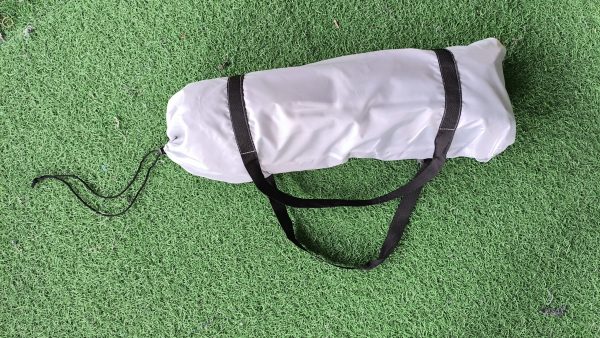
Depending on the use you make of your family tent, its weight may go from secondary to crucial.
Large camping tents can quickly become heavy or even very heavy. 44-66 lbs (20-30 kg) for some of them!
If you do a lot of hiking, backpacking or biking, choose a family tent that is as light as possible.
You can find an ultra-light 4-person family tent starting at 6 lbs (3 kg). This is the ideal! Very easily transportable.
However, a light family tent weighing 8 to 13 lbs (4-6 kg) will also be an interesting choice.
Note: for more backpacking light tents, I wrote a special guide: Best 1-Person, 2-Person, 3-Person and 4-Person Backpacking Tents 2019
On the contrary, if you travel by car and usually stay in the same place for several days, you will probably attach less importance to the weight of your tent. And certainly not at the expense of other comfort criteria.
Also think about the volume of the tent when it is folded and make sure you have room to carry it in the trunk of your car and store it at home.
In order to reduce the amount of space your tent takes up when folded, you can use a compression bag.
Tent shape
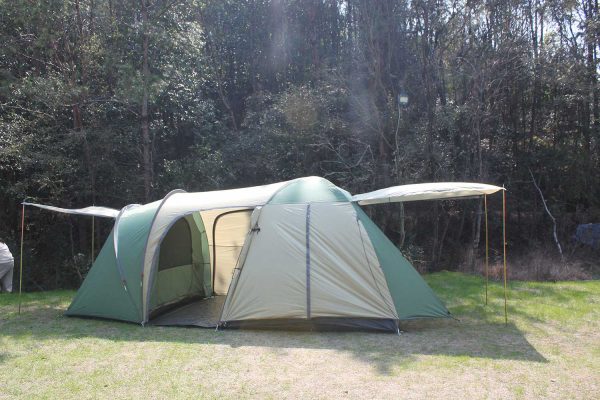
There are different forms of family tents with their advantages and disadvantages.
There are 4 different types of family tents:
- Dome or igloo: Dome or igloo tents are mostly self-supporting, i.e. they stand on their own, even without guy lines. They are easy to assemble and stable.
- Tunnel: Tunnel family tents are more spacious and usually quite high. They offer a comfortable interior with large apses for storing equipment and one or more bedrooms.
- Hybrid: The hybrid tent is a mix between dome and tunnel tents. Composed of two arches forming a dome extended by an awning, it thus makes it possible to combine the advantages of both types of tents.
- Teepee: With its pyramidal structure and central pole, the teepee tent has a unique charm. Its interior is generally quite spacious and you can stand in the middle. Very user-friendly, some teepee tents are even compatible with the use of a wood-burning stove.
Organization of the family tent
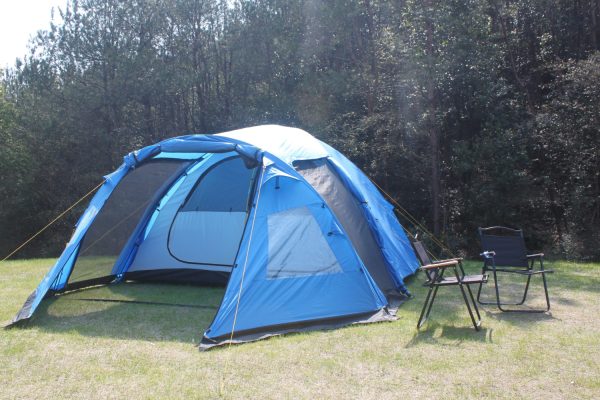
Family tent with awning, with vestibule, with kitchenette…
The family tent can contain many spaces to accommodate the whole family.
Define the tent organization that suits you.
Do you want a spacious family tent or do you prefer a light and compact tent?
It all depends on how much time you spend in it and what you do. It is very practical to have a vestibule when it rains and to share moments with the family (board games, meals…) or an awning to enjoy the landscape while sheltering from the sun.
Weather resistance
Weather resistance is an important criterion when buying a tent cover. Three criteria are to be taken into account:
- Waterproofing / Water resistance: It is essential to choose a waterproof family tent. Which can take at least light rain, or even more if you go to a rainy area.
The waterproof rating of a tent fabric is measured as the water column expressed in mm of water that the tent can receive before the water passes through the fabric.
The European standard for waterproof fabrics sets a minimum of 1500 mm. Check customers reviews regarding the waterproof rating of the fabric and the seams to avoid unpleasant surprises!
Also check that the floor is watertight to avoid flooding. Finally, for better insulation and less condensation, opt for double roof tents.
- Wind resistance : Another criterion you could check in the customer reviews section. Even if the important thing is often to pitch your tent in an optimal position in relation to the wind and by tensioning the guy lines!
- Anti-UV protection: By choosing an anti-UV canvas, you will be protected from the sun’s rays and will be able to sleep in more easily in the morning.